

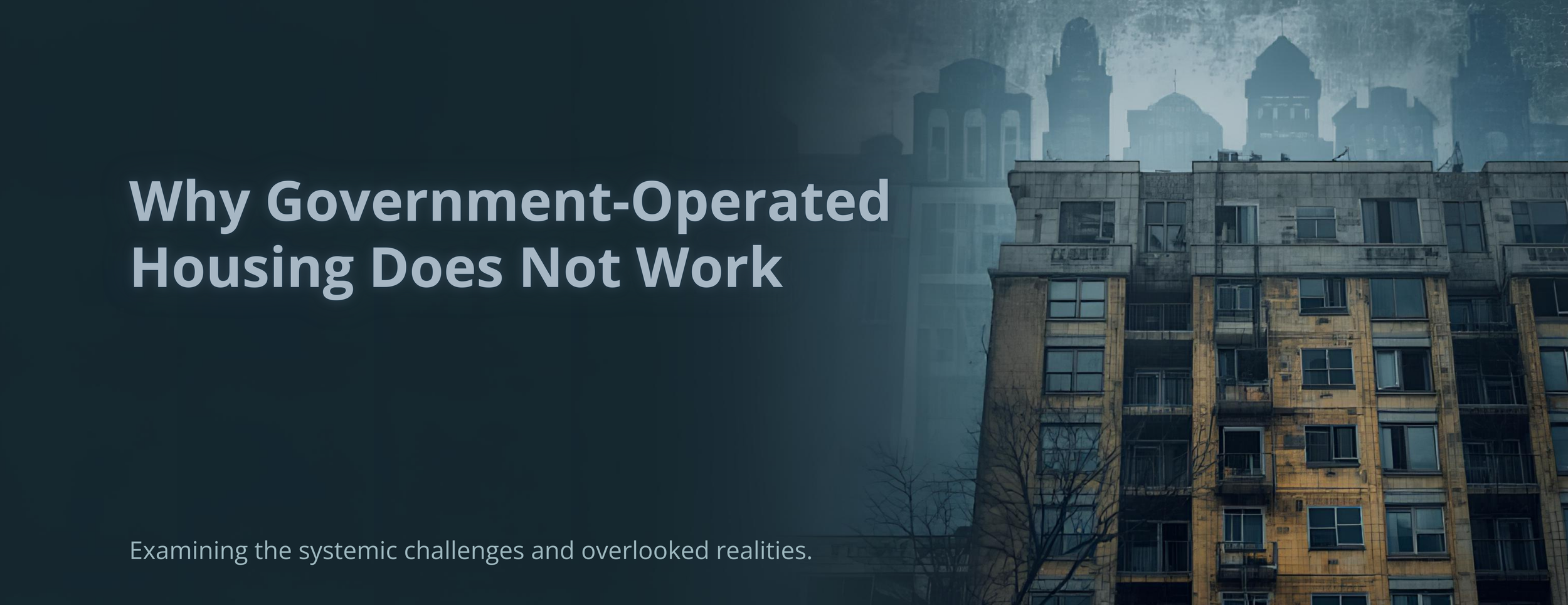
Quality Housing Requires More Than Government Programs
Government-operated housing was created to provide safe, affordable homes, but you may have seen firsthand how often it falls short. When you are searching for reliable rental properties in Maryland, you deserve more than long waitlists, neglected buildings, and slow responses to basic needs.
Marquise Properties focuses on professional property management and high-quality rental experiences. By understanding why government-operated housing struggles, based on documented patterns of underfunding, repair backlogs, and systemic inefficiencies, you can better see how a dedicated, private management team can deliver the stable, respectful living environment you want for yourself or your investment.
Why Government-Operated Housing so Often Fails Residents
Government-operated housing has a long record of struggling to meet even basic quality standards. This is not simply a matter of perception; it is rooted in structural problems that repeat across cities and states.
Severe Underfunding and Backlog in Repairs
Public housing is frequently and chronically underfunded. Operating budgets often do not keep pace with the true cost of maintaining aging buildings, modernizing systems, or addressing safety issues. When funds are insufficient:
Essential repairs and upgrades are postponed, sometimes for years.
Plumbing, heating, and electrical systems are allowed to deteriorate until they are unreliable or unsafe.
Roof leaks, mold, pest infestations, and broken common areas accumulate without timely resolution.
This ongoing underinvestment produces a growing backlog in repairs. Housing authorities regularly report thousands of outstanding work orders, and residents are forced to live with broken fixtures, malfunctioning appliances, and unsafe shared spaces because the system cannot keep up. Over time, once-viable properties slide into disrepair that is far more expensive, and sometimes impossible, to reverse.
Neglected Living Conditions
Severe underfunding and large repair backlogs translate directly into neglected living conditions for residents:
Units often have peeling paint, damaged flooring, non-functioning elevators, or inadequate heating and cooling.
Health-related issues like mold, dampness, and pests are left unaddressed for extended periods, contributing to respiratory and other health problems.
Common areas, stairwells, and exterior grounds are poorly lit, poorly maintained, and feel unsafe.
These conditions undermine the core purpose of government-operated housing: to provide safe, decent, and sanitary homes. Residents are left feeling that their well-being is not a priority and that complaints rarely lead to meaningful change.
Bureaucratic Inefficiency and Slow Response
Bureaucratic processes in government-operated housing often make even simple issues difficult to resolve. Multiple layers of oversight and rigid procedures create barriers at every step:
Residents must complete forms, attend hearings, or wait for inspections before basic repairs are approved.
Maintenance staff are constrained by strict work order systems and limited authority to act quickly.
Approval chains are long, and decision-makers are often removed from day-to-day conditions on the proper.
As a result, residents may wait weeks or months for answers about maintenance, unit transfers, or basic services. This bureaucratic inefficiency means urgent issues, such as broken locks, malfunctioning heat, or serious leaks, do not receive timely attention. The lack of responsiveness creates frustration, stress, and a sense that no one is accountable for results.
Concentrated Poverty, Social Isolation, and Segregation
Government-operated housing frequently groups many low-income households into large, isolated complexes. This concentration of poverty has well-documented negative effects:
Concentrated Poverty limits nearby job opportunities, discourages private investment, and reduces access to grocery stores, healthcare, and other basic services.
Social Isolation arises because many properties are physically or socially separated from more economically diverse neighborhoods, reducing residents' exposure to networks, role models, and opportunities that support upward mobility.
Segregation is reinforced when government-operated housing is disproportionately located in already marginalized neighborhoods, away from high-quality schools, reliable public transit, and well-maintained public spaces.
These patterns are not accidental. Zoning decisions and siting practices have historically placed public housing in areas with fewer resources, thereby deepening existing racial and economic divides. Once established, this segregation makes it harder for residents to access better schools, safer neighborhoods, and jobs with advancement potential.
Increased Wear and Tear Without Matching Maintenance Funding
Because many low-income households are concentrated in a small number of buildings, the physical structures experience higher daily use and faster wear and tear:
Elevators, hallways, play areas, and building systems are heavily used but not maintained with the same intensity.
Funding formulas often do not increase proportionally with the true cost of maintaining high-density properties under constant strain.
Without aligned funding and proactive management, this heavy use accelerates the decline of the property. The same residents who are meant to benefit from affordable housing end up living in deteriorating environments where problems multiply faster than they are resolved.
The Result: A Cycle of Decline
Severe underfunding, bureaucratic inefficiency, concentrated poverty, social isolation, segregation, and mismatched maintenance funding reinforce each other. Underfunding leads to a repair backlog and neglected conditions. Poor living conditions contribute to social and economic isolation. Concentrated poverty and segregation make it harder to attract investment or policy changes that would reverse the trend. The cycle continues, and the quality of life steadily declines for the very people government-operated housing was meant to help.
How Professional Management Creates Better Rental Experiences
Private, professional property management can break away from this cycle by focusing on accountability, clear expectations, and consistent care. With Marquise Properties, both owners and tenants benefit from management practices that directly address the failures common in government-operated housing.
Instead of chronic underfunding, we work with owners to plan realistic budgets that support timely repairs and ongoing maintenance.
Instead of rigid bureaucracy, we use streamlined processes and defined service standards to ensure prompt responses to maintenance and resident concerns.
Instead of neglect, we prioritize proactive inspections, regular upkeep, and timely follow-through on work orders.
We provide full-service property management, including leasing communications, maintenance coordination, and rent collection, so issues get handled instead of overlooked. Clear rental requirements and application guidelines help set expectations from the start, which creates more stability for residents and more predictability for owners of rental properties in Maryland.
Our approach also includes décor and staging services to improve the look and feel of each home. This attention to detail supports better occupancy, more respect for the property, and a higher standard of living than what many residents experience in government-operated housing environments that struggle with backlog and neglect.
Responsive maintenance request handling grounded in defined response times
Clear communication with tenants and owners to avoid confusion and delay
Online rent payment options for added convenience and transparency
Décor and staging to improve property appeal, comfort, and resident pride
What You Can Expect When Working with Marquise Properties
If you own or invest in rental properties in Maryland, our team manages the day-to-day work so your asset is cared for and your residents feel supported. We focus on preventing the patterns that undermine government-operated housing:
Organized leasing communications to reduce confusion and processing delays.
Prompt coordination of maintenance to avoid building a backlog of unresolved issues.
Consistent follow-up so that small concerns do not grow into major, costly problems.
For tenants, we offer straightforward rental requirements, online payment options, and a defined process for maintenance requests. Our MP Plus premium membership program is designed to add extra convenience and value, helping create a smoother, more predictable rental experience than what is often available in government-operated housing, where repairs, approvals, and communication can be slow and inconsistent.
Why Choose Marquise Properties Over Government-Operated Options
Government-operated housing is often limited by outside budget decisions, political priorities, and entrenched bureaucracy. These constraints produce chronic underfunding, long repair backlogs, neglected living conditions, and environments marked by concentrated poverty and segregation.
Marquise Properties is structured differently. Our focus is directly on property quality and resident satisfaction:
We work to ensure funding levels match the real needs of each property so that repairs and upgrades are not indefinitely postponed.
We design management processes to be responsive and transparent, reducing the delays and confusion common in bureaucratic systems.
We aim to offer homes in communities that are better connected to schools, transportation, and services, helping avoid the isolation and segregation associated with many government-operated housing developments.
Marquise Properties also supports investors with access to foreclosure, bankruptcy, as-is, and tax lien listings across the United States, helping you identify opportunities beyond traditional channels. Combined with our high-touch customer service and commitment to "Quality Living for All," we position your property as more than just a unit. It becomes a place where expectations are clear, communication is consistent, and living conditions are actively maintained, in clear contrast to the systemic failures that often characterize government-operated housing.
Discover Better Housing Options With Us Today
If you are ready to move beyond the limits of government-operated housing, we invite you to explore our carefully managed rental properties in Maryland. At Marquise Properties, we focus on providing safe, well-maintained homes and responsive service so you can feel confident about where you live.